PHIZ: Making Public Health Innovation Easier to Adopt and Sustain
Table of Contents
Public health teams often face similar operational problems, with limited capacity to develop and maintain their own solutions. The Public Health Innovation Zone (PHIZ) began as a way to share the innovation work at Wellington-Dufferin-Guelph Public Health (WDGPH), so that other health units could use it. Our first year brought interest from across Ontario and showed us how much the path to adoption depends on local capacity, privacy review and the practical experience of trying a tool. In 2027, we want to make that path easier and bring more public health teams into developing and sustaining the work.
This article is adapted from the slides and accompanying notes for my presentation, “Public Health Innovation Zone: What’s Next?”, delivered on November 20, 2026, in Guelph at The Future of Public Health: AI, Automation & What’s Next.
What we learned in our first year #
We published our first PHIZ article on December 12, 2025. 11 months later, we had 23 articles and guides, made ten codebases publicly available, and recorded about 15,000 site views. We had also tracked 61 engagements involving 18 other Ontario public health units.
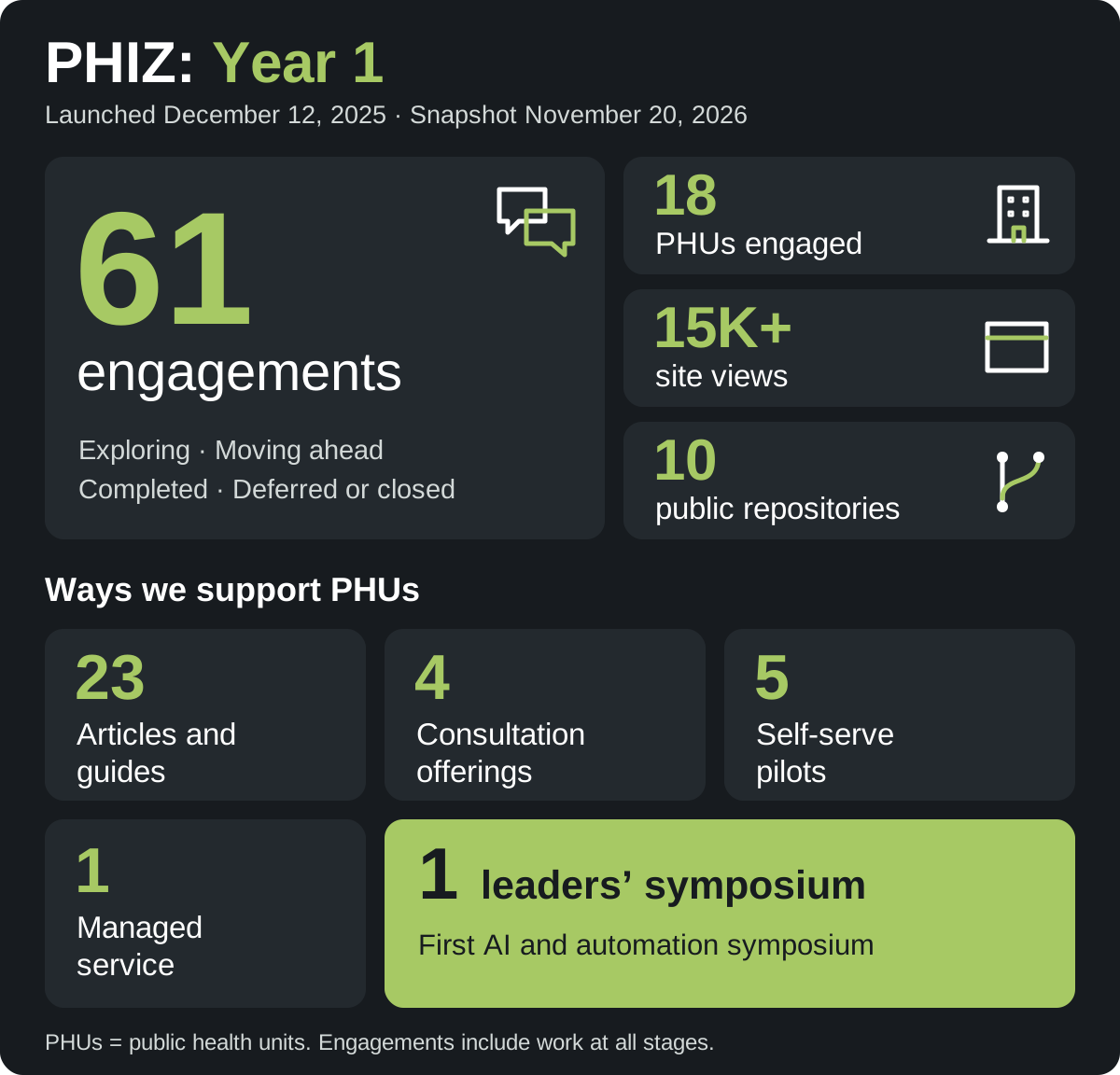
Those engagements took different forms. Some teams wanted advice on data infrastructure. Others were ready to pilot a tool, or asked us to produce their immunization notices as a managed service. Some conversations never moved beyond an expression of interest or a first meeting.
The scale of this work led us to move from a spreadsheet to a customer relationship management system, which now helps us track the engagements. The numbers describe our reach and activity. We still need to understand more consistently what happens after a tool is introduced, whether it becomes part of routine work, and what difference it makes.
Five lessons from that first year are shaping what we do next.
Make adoption workable beyond the codebase #
The pilot that really got PHIZ moving was our custom immunization notice system, now called ImmuKnow. It produces notices tailored to a person’s immunization record, with flexibility that is difficult to achieve through Panorama or a conventional mail merge.
During the 2025/26 school year, about ten health units used it as a managed service. This could involve multiple waves of notices, for school and child-care immunization programs, often in both English and French. The efficiency of the tool allowed a small team to provide that service at no cost to participating organizations. In return, we received feedback and a wider range of requirements that helped us improve it.
Of those health units, only one that we know of took the code, adapted it and operated it independently. Some are continuing with the managed service for a second year.
I have spent quite a bit of time thinking about that. Many of our colleagues work with code, but analytical programming and maintaining an operational application call for different experience. A team may be comfortable running a tool and still reasonably worry about what happens when something breaks.
There are organizational questions too. Where can the application run? Who will support it? Will corporate IT approve it? Is developing that expertise worthwhile for a tool used during a few campaigns each year? If the team makes an improvement, will they feel comfortable contributing it back through GitHub?
These are reasonable considerations for a public health leader. A managed service may remain the best fit for some organizations, while others want the control and capability that come with running a tool themselves.
We remain committed to open-source development. It supports transparency and keeps a route open for collaboration whenever another team is ready. Our first year has made us more attentive to the support and operating arrangements that help organizations use what we publish.
Share a useful starting point for privacy review #
One of the most common questions we received was: “Could you share your privacy impact assessment?”
Usually, we did not have a project-specific assessment ready to send. Our privacy assessments had focused on the building blocks used to write code, collaborate and manage software dependencies. That work supported our own development environment, but adopting organizations were asking about the complete tool and how they would use it.
Without quite realizing it, we had crossed into offering a product.
PanoReady is a useful example. It performs about a hundred data-quality checks on student enrolment files and can automatically resolve many of the issues that prevent those records from being imported into Panorama. For each release, we run and publish automated tests that take the workflow from beginning to end without network access.
Those tests provide useful evidence that the tested workflow can function offline. A privacy review also needs to consider the intended use, data handling and responsibilities within the adopting organization. We had technical evidence available, but had not packaged it in the form colleagues needed.
This is becoming more pressing. From January 1, 2027, institutions subject to Ontario’s Municipal Freedom of Information and Protection of Privacy Act must conduct privacy impact assessments before collecting personal information, subject to prescribed exceptions.1
We want to provide a shareable foundation that helps each health unit complete its own review with less repeated work. That could bring together the intended data flows, controls, test evidence and assumptions about how a tool will be used. Local differences would still need assessment.
For PHIZ, privacy documentation needs to become part of preparing a tool for adoption. Colleagues who help improve that documentation are also making a contribution to the project.
Let people try a tool at a realistic scale #
We gave many demonstrations during those 61 engagements. Some stayed too abstract.
Explaining how PanoReady repairs a postal code is useful. Giving someone a file representing 25,000 students and letting them see the problems identified and corrected makes the workflow much easier to understand.
Getting to that experience with real data can require a privacy assessment, IT review and installation support. For some health units, implementation could be six months or more beyond the first meeting. A tool we thought was ready to use still had substantial prerequisites.
Realistic synthetic data can help people explore its value earlier. When we profile enrolment data, we already measure which fields are missing, how often errors occur and which problems appear together. Those patterns can inform generated examples at the scale a health unit actually works with.
We want that kind of synthetic data to become a default part of PHIZ projects, available alongside the tool. A colleague should be able to see how the workflow behaves, understand the outputs and identify questions for their team without first obtaining permission to use real student records. A trial with synthetic data would support the decision to proceed with local review.
We also want fewer installation requirements and more approachable interfaces. PanoReady and ImmuKnow Studio show what can be offered through a browser. VaxLink uses a browser extension to bring functionality into an existing clinical workflow. Each approach can make a tool more accessible, although the setup and approval requirements differ.
The aim is to give program staff a useful experience early enough to help shape the adoption decision.
Show what infrastructure makes possible #
Some projects depend on more substantial infrastructure, and we have sometimes been hesitant to share them through PHIZ because of that.
Our Well Water SMS project sends an alert on the same day we learn that a well owner has an adverse test result. Behind that message is a data pipeline, storage, a communications platform and a team that can operate them.
Once those foundations are available, they can support further public health work. We are researching whether weather forecasts and geospatial information can help estimate well-water risk and inform testing reminders. In immunization, the ability to customize and electronically deliver notices creates opportunities to compare different messages and assess which work best for different recipients. It also supports work on affirming notices that could help build a more positive relationship between families and public health.
These are research directions underway at WDGPH. Their effectiveness still needs to be evaluated. The infrastructure makes it possible to ask and test those questions.
For leaders, this is part of the case for investing in shared technical capabilities and the people who operate them. The value can extend across several programs, and some opportunities only become apparent once the foundations exist.
PHIZ should make those dependencies visible. Alongside standalone tools that a health unit can try quickly, we need to explain what more substantial implementations require and what they enable.
Design human oversight into the workflow #
Generative AI adds another implementation challenge: how people review its work.
WDGPH now transcribes the voicemails the health unit receives, with more than 17,000 processed in the first year of operation. Key details are extracted, messages are categorized and scored for sentiment, and each message enters a queue for staff follow-up.
A short voicemail is relatively quick to check against a suggested category. The review task becomes more demanding when the source is a lengthy scanned document with many extracted fields.
We estimate that our volume of converting unstructured text into structured data could grow roughly tenfold by 2027. The anticipated work also includes more complex material, such as laboratory results, immunization records, vaccine fridge logs and incident reports.
If staff must read every page to verify every extraction, much of the potential benefit disappears. Sustainable use requires deliberate choices about what people review, when they intervene and how errors are identified.
Human oversight should reflect the consequences of the decision. Some workflows may require review of every output. In others, exceptions or uncertainty may trigger review, with ongoing checks to assess how the process is performing. A confidence score alone does not establish that an output is safe to use.
The comparison should include the quality and workload of the existing process. We need to understand whether a redesigned workflow maintains or improves performance, how errors affect people, and whether the review burden is manageable.
This builds on the proportionate approach described in our first-year account of AI governance. PHIZ can help by sharing the review arrangements and operational challenges alongside the technical implementation. Those details will often determine whether another organization can use a similar approach responsibly.
Build a community around the work in 2027 #
These lessons give us a practical direction for PHIZ’s second year.
We want a refreshed project portal to bring together the material another health unit needs to assess a tool: user and contributor guides, realistic synthetic data, privacy-assessment foundations, related articles and the code. More projects should offer browser-based trials with fewer prerequisites. Demonstrations should be useful on their own and easy to share with colleagues.
We also want more projects to have a community around them.
VaxLink is the first PHIZ-incubated innovation with its own community of practice. A focused monthly check-in brings developers together with people using the tool in clinics. Developers explain what has changed, users describe how those changes work in practice, and quality-improvement colleagues help identify what to measure.
When someone raises a question, everyone hears the answer. The person who has already worked through the issue may be at another health unit.
That is a more sustainable way to support a growing group of organizations than repeating the same conversation separately with each one. It also creates room for contributions from people whose expertise is in clinical practice, privacy or evaluation.
We are starting an opt-in newsletter to share new articles and significant project updates. We are also welcoming article authors and pilot hosts from outside WDGPH. PHIZ should become a place where peers can learn from the innovation work happening across public health.
Choose a project and tell us what it would take #
The next step can be quite specific: choose a PHIZ project relevant to your team and tell us what would be needed to use it in your health unit.
That conversation should include the people who would use it and those responsible for supporting it. The missing piece may be a privacy assessment, a clearer guide, a local technical contact or a way to evaluate whether the change is worthwhile.
If your team has already participated, consider what would have made the experience easier for the next organization. A missing step in a user guide, the measures used to assess a pilot, or an account of an implementation difficulty can all help sustain the work.
Our first year gave us a clearer understanding of what sharing innovation asks of both the team developing a tool and the organization adopting it. In year two, we want to use that experience to make useful public health work easier to carry from one organization to another.
Get in touch with the PHIZ team to discuss a project or contribution.
Information and Privacy Commissioner of Ontario. Frequently Asked Questions: FIPPA and MFIPPA Amendments. The guidance describes the January 1, 2027 requirements for institutions subject to MFIPPA, including PIAs before collection and updates before significant changes to the purpose of use or disclosure, subject to prescribed exceptions. https://www.ipc.on.ca/en/resources/fippa-mfippa-amendments-faq ↩︎